The History of Moonshine in Arkansas — And Why It Still Matters Today
Published by Crystal Ridge Distillery | Hot Springs, Arkansas
Moonshine has a reputation. Backwoods stills. Midnight runs. Mason jars passed between strangers who knew better than to ask questions.
That reputation isn't entirely wrong. But it's only part of the story.
The full story of moonshine in Arkansas — where it came from, why it thrived here, and what it means today — is a story about family, survival, and a craft that refused to disappear no matter how many laws were passed against it.
At Crystal Ridge Distillery, we don't just tell that story. We live it.
Where It All Began
To understand moonshine in Arkansas, you have to go back further than Arkansas itself.
The tradition of small-batch distilling came to the American frontier with the Scots-Irish settlers who poured into the Appalachian Mountains and the Ozark and Ouachita highlands throughout the 1700s and early 1800s. These were people who had been distilling grain spirits for generations in Scotland and Ireland — it was part of their culture, their economy, and their daily life.
When they arrived in America, they brought the craft with them.
Corn and rye grew well in the highland hollows. Water ran cold and clear from mountain springs. The knowledge was already there. It didn't take long for distilling to become part of the fabric of frontier life across the South and the Ozarks.
The Whiskey Rebellion and the Move West
In 1794, the federal government tried to tax distilled spirits for the first time. The response from frontier farmers — who depended on distilling as a way to convert surplus grain into a transportable, tradeable commodity — was swift and angry.
The Whiskey Rebellion was put down, but the resentment it created never fully disappeared. Many distilling families simply moved further west, deeper into the frontier, away from federal reach.
This is part of the story of how distilling culture made its way into Arkansas. Families followed the ridgelines and the river valleys, carrying their copper pot stills and their recipes with them, settling in the Ouachita Mountains and the Arkansas River Valley where the terrain and the water were right.
Moonshine in the Ouachita Mountains
The Ouachita region — running from central Arkansas into eastern Oklahoma — became one of the most significant moonshining areas in the American South.
The reasons were practical. The mountains provided cover. The hollows and creek beds hid stills from view. The hardwood timber fueled the fires. And the spring water — cold, clean, mineral-rich — produced a spirit that serious drinkers recognized as something special.
Moonshine wasn't just a luxury out here. For many families, it was an economic necessity — a way to turn corn and grain into cash money in an economy that didn't have much of it. A bushel of corn might bring a few cents at market. Turned into whiskey, that same bushel was worth several times more.
The law, naturally, saw things differently.
Prohibition and the Golden Age of Moonshine
Moonshining in Arkansas predated Prohibition by over a century — but Prohibition, which ran from 1920 to 1933, turned it into something much bigger.
With legal alcohol suddenly unavailable, demand exploded. Every small-town doctor, businessman, and ordinary drinker who wanted a bottle had to find one somewhere. The moonshiners of the Ouachita hills were ready to supply them.
Hot Springs, Arkansas — already famous for its thermal waters, its horse racing, and its gambling — became one of the most wide-open towns in the South during this era. The city operated under a tacit understanding between local law enforcement and the operators of illegal establishments. Illegal liquor flowed. Nobody asked too many questions.
It was a complicated, colorful, and deeply human chapter in Arkansas history.
After Prohibition — A Craft That Survived
Prohibition ended in 1933, but moonshining didn't. Legal distilling resumed, but heavily taxed and regulated. For the families who had been distilling for generations — who saw it as a craft and a heritage, not a criminal enterprise — going legal meant surrendering something that felt like a birthright.
Many kept going. Quietly. On back roads and in hollow valleys, the stills kept running well into the second half of the twentieth century. The craft survived not because it was profitable — the legal market made that harder — but because some families simply couldn't imagine stopping.
It was in their blood.
The Bradley Family — Seven Generations in Garland County
The Bradley family's connection to distilling runs deeper than most.
Lawrence Bradley IV — Crystal Ridge founder Danny Bradley's ancestor — served in the North Carolina Militia during the Revolutionary War and made his way to Arkansas before it was even a state, settling in Garland County in the early 1800s. He died here in 1828. His descendants never left.
Seven generations of Bradleys have called this same stretch of Arkansas home. They farmed it, built on it, raised families on it, and watched the land change around them — including in 1953, when Lake Ouachita rose behind Blakely Mountain Dam and swallowed the family's home community of Buckville beneath its waters.
They stayed anyway.
When Danny Bradley founded Crystal Ridge Distillery, he wasn't starting something new. He was picking up a thread that had been running through this family for over two centuries — a tradition of craft, of self-reliance, and of turning the grain and the water of this particular ridge into something worth sharing.
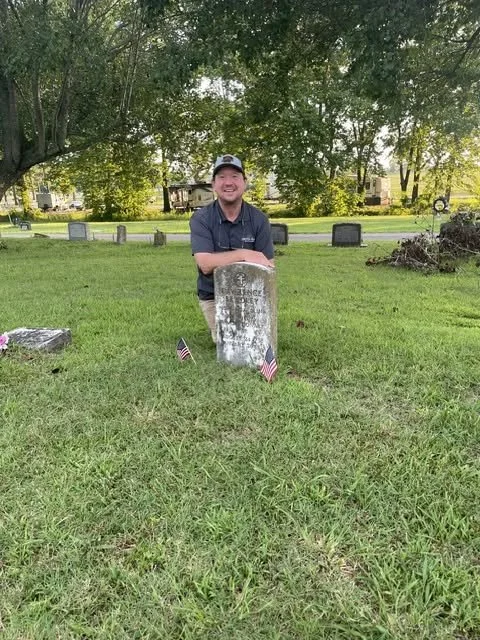
Danny Bradley at Lawrence Bradley IV's grave
The First Legal Distillery in Hot Springs
Crystal Ridge Distillery holds a distinction that connects directly to that long history — we are the first legal distillery in Hot Springs, Arkansas.
In a city with a moonshining tradition stretching back before the Civil War, in a region where families distilled in secret for generations, Crystal Ridge opened its doors at 455 Broadway and did it all above board — licensed, taxed, and proud of it.
It felt like the right way to honor the craft.
Today we make 14 moonshine flavors, an Arkansas Vodka distilled 10 times, and a line of ready-to-drink vodka cocktails called The Pack — all from the same building, using the same pure Hot Springs water that has made this region famous for over a century.
The still has a name. His name is Patrick. He's 250 gallons of copper and wood, and he sits in a building that was hand-built between 1910 and 1920.
The history is all around us. We just turned it into something you can taste.
Why Moonshine Still Matters
There's a reason moonshine has had a resurgence in American culture over the last two decades — and it's not nostalgia alone.
People are drawn to things that are real. Craft spirits made by real people in real places, with a genuine story behind them, offer something that mass-produced liquor simply cannot — authenticity.
When you sip Crystal Ridge moonshine, you're tasting a spirit made with Hot Springs water and the knowledge of a family that has been rooted in this ground for seven generations. You're tasting something that connects directly to one of the most distinctly American traditions in our history.
That's what moonshine has always been about. Not the lawbreaking. Not the mythology.
The craft. The family. The land.
We're just the latest chapter.
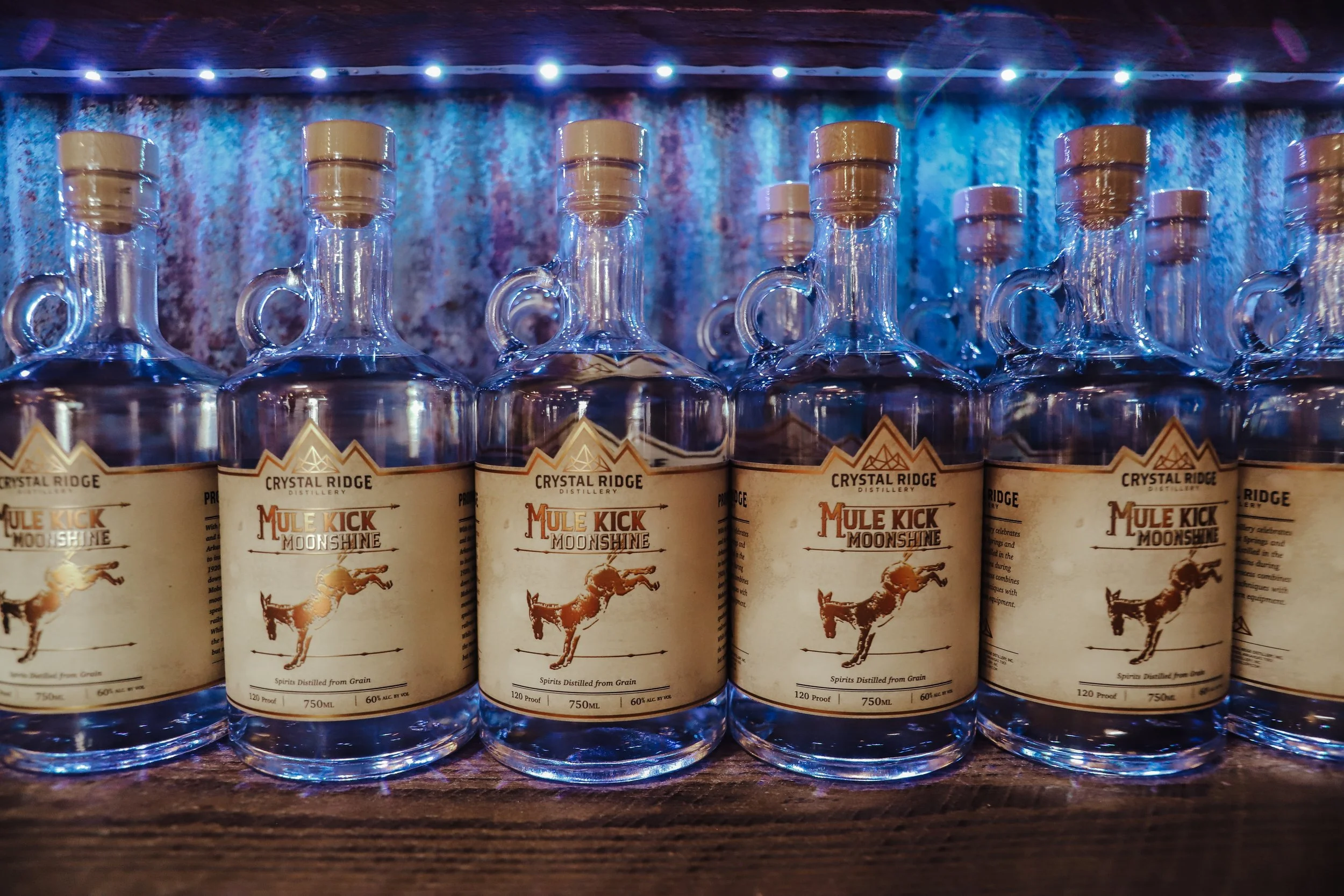
Mulekick Moonshine
Come Taste the History
Free distillery tours run throughout the week at Crystal Ridge Distillery. Our Moonshine Experts will walk you through the full process — from grain to Patrick the still to the bottle in your hand — and tell you the story of how we got here.
Tastings are $10 and include our full moonshine lineup, Arkansas Vodka, and The Pack RTD cocktails. No reservation required.
Tasting Room Hours:
Hours subject to change — call us at 501-627-0722 or follow @crystalridgedistillery for the latest.
Monday: 12:00 PM – 7:00 PM
Thursday: 12:00 PM – 7:00 PM
Friday: 12:00 PM – 8:00 PM
Saturday: 12:00 PM – 8:00 PM
Sunday: 1:00 PM – 7:00 PM
Tuesday & Wednesday: Closed
455 Broadway St, Hot Springs, AR 71901
Crystal Ridge Distillery — the first legal distillery in Hot Springs, Arkansas. Seven generations of Bradley family craft, rooted in Garland County since before Arkansas was a state.